Visualizzazione post con etichetta Sabbath. Mostra tutti i post

venerdì 21 dicembre 2018

Yule - The Magic of Winter

During my teenage years, I found Christmas an essentially commercial, empty festivity: a façade of joy and dazzling lights on a crumbling building, dark and cold. The hyperbole of our society, where everything looks beautiful thanks to Instagram filters and by filling our inner emptiness with shopping carts full of consumer goods.

At an older age, however, I found myself appreciating more this celebration, having learned the arcane meaning behind it: the Winter Solstice. The triumph of the Sun over the darkness, celebrated for millennia by many peoples.

And it is there that the songs in the streets and shops, the lights in the windows and the glittering decorations on the tree echo with ancient laughter, joys and gifts exchanged by the light of fires lit during the long night.


Astronomically speaking, the winter solstice represents the moment in which the Sun reaches, in its apparent motion, the lowest point on the horizon, and then begins to rise in its path up to the highest point (the summer solstice) . This lack of light and warmth, led to the birth of many legends and festivities, linked to this suggestive moment of the year.

Two main themes recur: the darkness, the real heart of the cold season, often represented as an elderly figure, and the light, reborn after the longest night.

For the Neopagans, the solstice represents Yule, the first sabbatical feast of the year: the Goddess gives life to the God, the child Sun, who carries with him the promise of a warm spring. The name of the festival derives from the feast of Juul, a blot celebrated in pre-Christian Scandinavia. It was a moment of joy, of recollection but also of sacrifice: we must remember that, while today we are accustomed to our weekly shopping at the supermarket downtown, winter represented a season of famine for our ancestors. It was customary to sacrifice the flocks to the gods, thus ingratiating their favour, eating the meat with their loved ones and avoiding a death of hardships to livestock during the harsh winter.

From Northern Europe, we have inherited some of today's traditions such as the Yule log and the Christmas tree, which is spontaneously associated with Yggdrasil, the axis mundi.

 According to the legend, St. Boniface, who christianised Saxony and Friesland, on his way back to Rome, had a large oak tree cut, a tree sacred to the local pagans.
From the roots of the oak, a fir tree was born magically and St. Boniface interpreted this event as a divine sign, representing the goodness of Christianity.
However evergreen trees were known, in the pagan tradition, to bring prosperity and resistance during the winter season and for this they were taken to homes and hung to attract good luck.
It goes without saying that a sign of this kind should be interpreted as paganism (the fir tree) resisting the obscurantism of Christianity (the oak, which in the cold season loses its leaves).
The evergreens were also the sacred trees to the god Baal, a solar deity

Another tradition linked to evergreens is the "Yule log", known also as the "Christmas log". Usually it is a very large log, lit in the fireplace on the evening of Christmas Eve and meant to be burn up to the Epiphany.
By tradition, it helps driving away the evil spirits that roam the earth during the Solstice and serve to "strengthen" the life force of the Sun, which at this time of the year is weaker.

Even the famous figure of Santa Claus is of Scandinavian derivation: before being associated with the chubby bearded man we all know, he was portrayed as a very tall old man, dressed in black on horseback. A figure far from reassuring and good-natured, compared to that on the bottle of Coca Cola.
This spectral figure was associated with Odin and his horse.
During the longest night of the year, Odin kept a hunt (the Wild Hunt) along with other deities and spirits. The children in the villages used to put their boots out of the door, full of vegetables to feed the hunters' horses; in return they found the shoes full of gifts.

A somewhat more modern conception of Santa Claus, which helped to spread the tradition all over the world, is the one described in Clement C. Moore's poem "The Night before Christmas", published for the first time in 1823.

Inspired by various legends related to Santa Claus, Moore wrote this poem in which Santa Claus is described but as a small elf, fast and old, so minute to enter the houses through the chimneys, which he reached by flying over the roofs in his small sled , towed by eight reindeer. This little elf is called St. Nick.
For fans of ancient Anglo-Saxon traditions, the approach of St. Nick with Old Nick, one of the many names used to refer to the Devil, will not have escaped.

Similar concepts, put in the shade by the now-ubiquitous Santa, are found in various interpretations around Europe (see Befana, St Lucy, St Nick and the Three Kings just to name a few).


*** Click here to read our article on Krampus, the Wild Hunt and other winter traditions.

The rebirth of the sun during the winter solstice period is a theme common to many pagan traditions, so much so that the emperor Aureliano established on December 25th "dies natalis Solis invicti", thus giving to all the different cultures present in the Empire Roman a common day to celebrate the glory of the Sun.

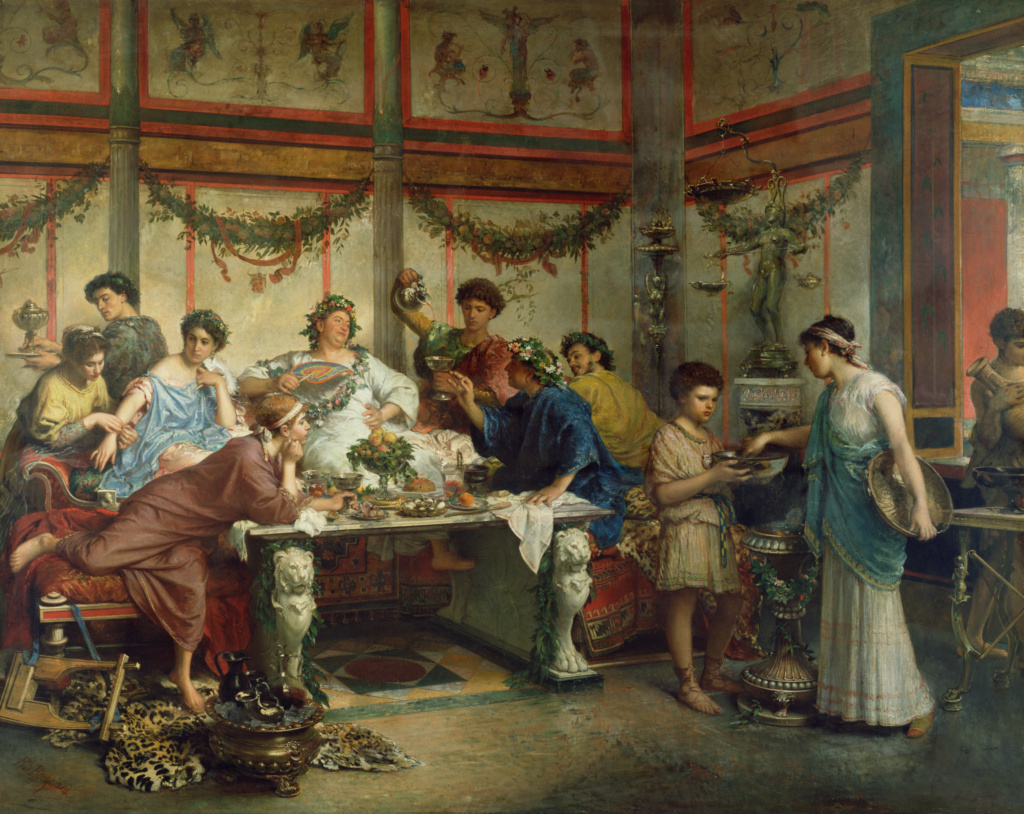
Also in this period, in Ancient Rome, the Saturnalia were celebrated between 17th and 23rd December. As it can be easily deduced from the name, they were festivals in honour of the god Saturn: it was custom, during these days, to exchange small gifts and illuminate the cities by day - other traditions certainly familiar to us. It was believed that the old god, out of the Underworld, was hovering over our dimensional plane, bringing with him the spirits of the deads; in order to make them find the road to the Underworld again, sacrifices were offered, songs were sung, fires were lit and people dressed up.

Moreover, the usual social order was not in force: the slaves were free, joining their masters in the celebrations held during the lavish banquets in honour of Saturn.


*** Click here to read our article on the Mundus Cereris, the opening of the Underworld according to the Roman tradition.

The recurring theme is always the same: the "old" that brings the "new", the old and wise darkness that slowly gives way to the light, to the hope of a new year and a new harvest.

Nowadays, we must not worry more about famines and about sharing the harvest with the people we love. We live in an abundant world, full of possibilities. So full to become redundant with it, to the point of losing the sense of joy in being together with those we love, overcoming the darkness.

Let us remember the meaning behind the glitter, behind those gifts bought without feeling and unfailingly recycled. The Solstice is the time to be grateful for what we have received during the year, to be aware of what we have learned during our descent into darkness and to take a new path into the light.

Let us be grateful for the ties we can cultivate around a laid table, be it our blood family or our family of choice. And if we really do not know how to spend our money, let us not buy junk that will end up in the trash: we can use our power to help those who do not have the same luxury.

The Solstice is a festivity linked to joy of the home, the Earth is our home. Let us give us the gift to help her, let us give our money to the associations that take care to protect the environment or people in need. And if we really can not use the money, we can use our time: we can volunteer ourselves, collecting the trash from the beaches and the ground, we give what we do not need to those who can use it.

The greatest gift is to be aware, for ourselves and for those around us.

Happy and prosperous Solstice.


♃Ludna & Unornya
Clicca qui per leggere questo post in Italiano 


venerdì 27 ottobre 2017

Samhain: A Time for Spirits and Legends

It is time for changes, we feel that in the air that gets colder, in the sun becoming cooler and in nature, beginning to change her colours. Autumn is here, this season invites us to introspect and reap the last fruits of the year, that is, all the experiences that, in the last year, have made us become a little more mature.
As we know, in this period the veil that separates our world and the world of spirits thins, until it reaches its peak of transparency during the magical night of Samhain. Precisely for this reason, it is a good idea to take advantage of it to increase our experiences, putting us in communication with the afterlife and the Gods.

samhain halloween all hallowsSince the beginning of time, human beings have always tried to get in touch with "elsewhere", trying with all of themselves to get answers on everything they could not explain; I think this is the reason why the Samhain has remained, in many traditions, a pagan festival in all respects.
As is well known to anyone who approaches the study of paganism, Christians supplanted all pagan traditions and festivals with their own, taking their main meanings and crippling them, giving them an "evil" nature, so that those who converted to Christianity did not have the temptation to return to those ancient practices.
Yule has thus become Christmas, Ostara has become Easter and so on, but the feast of Samhain, although the feast of All Saints has been established with the intention of replacing it, continues to have a certain influence as a popular feast; it has never completely transformed into a Christian holiday, but has kept that aura of magic that distinguishes it and has become a play party for children, that is the Halloween party in Anglo-Saxon countries such as England and the United States.

The energy at this time of the year is very palpable, it cannot be ignored, no one is immune to it and practically everyone, pagan or not, perceives its magic; it must be for this reason that the various customs, linked to the night of October 31st, are still handed down through the centuries.
The fact that our mind, if well trained, has the ability to communicate with other entities from other worlds and dimensions, may be one of the reasons that prevents us from forgetting about Samhain; our willingness to touch and reveal all that is dark and unknown, combined with the powerful charm that the supernatural possesses, makes it impossible for us to give up this festivity, since everything about it is part of us.

What is the true meaning of Samhain?

samhain halloween all hallows


The term Samhain itself is a word of Gaelic origin, (pronounced "Sow-wen") which refers to the act of harvesting the last crops sown during the year.
Similarly, this holiday represents a transition, from the hot to the cold season, from light to shadow; in fact, according to some scholars, the word Samhain also derives from the ancient Irish Samuin, which means "the end of summer".
The Celts were very superstitious about everything that was "between two things", in fact many legends speak of bridges, the threshold of the front door, crossroads, even the shore area near seas, lakes and rivers. .
Precisely for this reason, they dedicated the feast of Samhain to honouring the dead, as if to exorcise the fear that, during this "passing" night, they might return from beyond.

Torches and fires were lit up in order to allow the benevolent spirits to follow the lights and re-join their loved ones, while protecting them, at the same time fire removed all that was evil. For the same purpose, they used the lanterns made with the pumpkins that are still used today to be carved, and the monstrous disguises, which were used to confuse the evil spirits by making them believe that the person wearing these dresses was "one of them" and therefore induced them not to hurt them.

With the advent of modernity, the most frightening party of the year has been the protagonist of many rumours and legends, mostly by Catholics, but also by some pagans themselves and people influenced by horror films, of course we are talking about people who are not absolutely aware of the true tradition of Halloween.

In this article I would like to debunk some myths about Samhain and reassure those who starts the practice of paganism.

Urban Legends and Platitudes on Samhain:

samhain halloween all hallowsIs it a Satanic Feast?
First of all we need to distinguish what kind of Satanism we are talking about, since there is a huge difference between Spiritual Satanism, which is a form of paganism, and the Satanists you hear about on TV, the so-called Acid Satanism, or those who are committed to crimes in the name of the Christian Satan, the figure of Satan as represented in the Bible.
Samhain is an event connected to the cycle of nature, as the season changes, it is clear that therefore all the pagan currents, such as Spiritual Satanism, decide to adopt it as a celebration of great importance. At the same time, it is certainly not a festival invented by criminals to sow death and destruction, although unfortunately these people take the Samhain festival as a starting point for practicing brutality.
The world, in some ways, is full of mentally deviated people, so yes, there are people who practice senseless rituals where animals are killed, but all of this has nothing to do with Samhain and its traditions. Unfortunately, it is useless to sweeten the pill, bad people exist. It would be better to keep an eye on our pets closely, preferably keeping them home for the night, but without big dramas, because fortunately such episodes are rather rare.

Is it dangerous for children to celebrate?
Definitely not, for kids it is simply an occasion like another to have fun with friends, whatever their spiritual confession is. They do not run any risk of celebrating in monster disguises, the only risk to which they may be exposed is what is going on around the streets at late night, but it is a year-round problem, not just for this night.

Is it true that nothing esoteric should be practiced at this time of the year, as the veil is thin and so can be dangerous? Can you be in contact entities without wanting to?
samhain halloween all hallowsNothing more fake. Precisely because the veil is thin, we should take this time as an opportunity for spiritual growth, as we have more chances of obtaining good results from rituals with divinities and spirits. It is quite the same for new moon nights: many people argue that you should not practice with the new moon, as it has "malicious" influences, when it is simply the final phase of the lunar cycle, with its specific magic properties. As I have already said on other articles, one must not fear the "dark side" of things, but awareness is the key to spiritual growth.
To contact an entity, whether it is a deity or a spirit of any kind, requires a great deal of experience and sensitivity, obviously then, whoever is able to do so, has also the ability to handle the thing.
Those who are still inexperienced, can take the chance trying to connect more with their own nature of witch.

Halloween is the crippled version of the All Hallow’s Feast?
The same date was chosen, since the people, who were already celebrating the dead, would effortlessly get used to the new Christian tradition, even if the two celebrations, in fact, were never divided.
In fact, in the United States, as in all Anglo-Saxon colonised countries, it is customary to celebrate All Saints' Eve on this day, but in fact it is celebrated in the Celtic way, with carved pumpkins and sweets, as if the two holidays had merged, with the difference which is now called Halloween, that is the fusion of the two words "hallows" and "eve '" which mean "All Saints' Eve"
In conclusion: the answer is no, the Halloween party was born long before its Catholic version.

Samhain and the Spirits:

On this day, we honour our loved ones who have passed the veil.
In addition to leaving lanterns lit to drive spirits, people used to set an extra seat at the table to invite their deceased loved ones to join them once again for dinner, they served food without looking into the empty place, since if by chance they saw the deceased it would bring them bad luck, the remaining food was then left as an offering outside the window to feed the spirits.

Probably in this period we are all more sensitive and we perceive more everything that is supernatural. The human being is naturally attracted to it, the numerous themed films / books are proof of this.
Unfortunately, monotheistic religions have filled people's heads with real phobias of everything beyond their beliefs, many of us, even pagans, have lost the connection with the afterlife and with the Gods, which is a pity.

samhain halloween all hallowsIf you've ever heard something about the "contact with the dead", or  topics such as Ouija boards, automatic writing, trance, etc… you will certainly have noticed that the majority of users comment everything with "do not do these things , they are dangerous” or "do not mess with the dead"; Unfortunately, this is precisely the result of the work that monotheistic religions have perpetrated over the centuries on our minds and habits (just think of the difference in the relationship with the dead between places like India and Europe).
In the past the relationship with the deceased was more spontaneous, but nowadays that spontaneity has turned into fear, so much so that people refuse even to talk about it.
It is clearly a controversial topic and obviously you need skills, in-depth study of the subject, prudence and, above all, respect, as with all esoteric themed activities.
In fact, the same is true with divination: even when we decide to read the tarot we open portals, we ask for energy from elsewhere to help us in the interpretation, but divination done in this way is not frowned upon as the using an ouija board.

But at the same time, those who really want to return to original paganism must, sooner or later, strip off all these blocks and prejudices that have been instilled in us and begin to reconnect with our true nature.

A divination with the Ouija board, based on the preparation of the person leading, can be successful or evolve into a great confusion.
What is certain is that practically nothing you have ever seen in movies can happen, even if it is not an activity that should be taken lightly.
With proper precautions, you can have a very uplifting and safe experience.
Below, I leave you some tips for those who want to try this practice:

• First, you need to be sure that the people invited to participate are balanced and open to the esoteric world, the right dose of scepticism may be fine, but of course a person who refuses the idea of ​​contact with the spirits may affect the outcome of the session. (After all, if you were a spirit, how would you feel about talking to a person who does not believe in you?). At the same time, a person with psychic disorders can attract malevolent entities, attracted by the same energy they emanate.

• Create a comfortable environment for approaching a spirit: comfortable fabrics, high quality incenses, purify the environment with sage, salt and crystals, and use light-coloured candles. According to some, benevolent spirits are attracted by light and warmth, so the candles would act as a catalyst. If you are indoors, be sure to choose the hottest place of the home if you want to feel more protected, draw protective seals on the support you will use and surround yourself with a circle of protection. It is essential to face it all without restlessness as negative energy could attract non-positive entities (such as larvae, restless spirits, etc.)

• At this point, the person conducting the session, the medium, can decide whether to do a guided meditation for the people who participate, to help focus the intentions better. Later, they will ask the spirit to reach the group of people.
You can evoke spirits of the place, passing through, or, for the more practical, specific people (obviously, in the latter case, it is easier to evoke someone with whom you have had contact in life, perhaps using an object that belonged to the person or a photo).
The medium can make their request by speaking out loud or even singing, depending on how a person is used to acting. For example, a sentence that can be said is: "Is there any spirit nearby who would do us the honour of joining this group to speak?"
If the group is made up of people who are particularly united and spiritually formed, it is possible that more than one spirit will arrive; this should not be interpreted as something dangerous, just let them speak one at a time, listening to the messages they want to leave you.
A spirit from some of your past familiars might even show up.

• You can use many tools to contact the dead: Ouija table, tarot cards, pendulum, automatic writing … what you are most used to works best.

• If any of the entities that appear will be malicious or angry, it is good practice to try to end the session. The medium can talk to them saying, "Thank you for your presence here with us, but now I invite you back from where you came from.”

• When you decide to end the session, do not forget to thank the spirits and say goodbye (as you would do with living guests), inviting them to leave the session.

• If one of the participants seems to have fallen into a state of trance, DO NOT wake them up abruptly, but speak gently and guide them back into a waking state; there are good chances of having a message for the group once awakened.

• It is likely that, even if a spirit has said goodbye, it will remain around making its presence felt for a few hours, or appear in a dream the following night. This is perfectly normal, you don't have to worry.

Activities for Samhain:

samhain halloween all hallows


• Clean up the space you use to celebrate, alone or in company.
• Eliminate all the negative energies by dusting and burning sage and incense, you can also decide to consecrate space to the four elements.
• Only if you are able and feel safe, make a spiritual summoning in the way you prefer.
• It is the ideal night for divination, use the tarot cards, the runes, the pendulum, and all that it takes to get answers to you next year.
• Apple is the magic fruit par excellence, use apples to make cider, cakes, or garlands with dried apple slices. Bury some fruit as an offer to assure you a "good harvest" the following year.
• Offer food and drink to the spirits of nature.
• Cook something with the pumpkin (cake, biscuits,…) and engrave some seals; in this way they will boost the food that you will then eat.
• Of course, carve a pumpkin :)
Unornya
Per leggere questo articolo in Italiano clicca qui.

mercoledì 20 settembre 2017

Mabon - The Return of the Darkness.

The night between the 21 and the 22 September marks a very peculiar astronomic phenomenon: the Autumn Equinox, when night and day stay in balance. It is not a coincidence that the Sun is getting ready to enter in Libra - a zodiac sign that rules equilibrium. It is equilibrium indeed the main theme for the sabbat we celebrate on the Autumn Equinox: Mabon.

Compared to its spring equivalent, this period of the year marks another kind of balance: after this date, days will be shorter, the earth is getting colder, the animals are sheltering in their dens and the flocks are migrating towards South. It is then a conscious balance of that the earth is slowly dying and we need to get ready for a long descent in the Darkness - culminating with Yule, the longest night. 

Known also the “Second Harvest Festival”, Mabon is a moment of gratitude towards Mother Earth for all the bounty she gave us, before the winter. Most of the popular celebrations, in the Northern Hemisphere, converge around this topic:


  • Greeks used to celebrate Oschophoria, a festival in honour of the god Dionysus and the grape harvest.
  • In Germany we still celebrate the Oktoberfest, nowadays considered an opportunity to cheer and to drink but with a pagan background: people used to celebrate the harvest and the last stock of the summer beer. One last occasion to be grateful to the earth and clear the barrels before the winter brewing.
  • In China people celebrate the Moon Festival, one of the most popular and beloved Chinese recurrence: during this festival, it is customary to make moon cakes with rice flour from the harvest.
  • Originally Thanksgiving was celebrated around the 3rd October, in synchrony with the harvest.


For Neopagans, the Goddess is now becoming Chrone whilst the dying God is getting ready to be reborn (symbolised by the seeds in the fruit, harvested during summer). The God is often represented by a corn doll, whose body gets burned and its ashes scattered in the fields to bless the soil.

Another theme during this sabbat is the descent in the darkness and death. We are adventuring in the dark half of the year, the part that is inviting us to stop, reflect on what we achieved so far and start a journey within ourselves to transform what is not needed anymore through the mysteries of death.

The name Mabon itself is the name of a Welsh god of vegetation and harvest, meaning “Great Son” (from the protoceltic makwo - son), often depicted on a horse and with a hound.
According to the legend, Mabon had been kidnapped from his very mother Modron (“Great Mother” - from the protoceltic mātīr - mother) and eventually rescued by King Arthur. During his imprisonment, the earth fell into a sterile and cold gloom, which had been dispelled with Mabon’s liberation.

We have similar myths in Greece and Persia, with Mabon’s counterparts: Persephone and Inanna.


Proserpine by  D.G.Rossetti
Persephone, known to the Romans as Proserpina, was the daughter of Zeus and Demeter - the goddess of the harvest. After a deal between her father and Hades, she was kidnapped by the King of the Underworld to become his wife. Demeter, suffering from a tremendous sadness, left the soil dying. Zeus, concerned that this eventually would have put an end to life on earth, came to terms with his brother Hades: Persephone finally could have been with the mother again; however Hades gave her six seeds of pomegranate before she left. In this way she could spend six months with the mother (spring and summer), when the earth was again covered in flowers and fruits, and six months with her husband (autumn and winter) in the Underworld. 
The pomegranate is both symbol of fertility and death: it was used in funerary rituals from both Egyptians and Greeks. It represents a juicy and dying fruit - the last gift from a tree ready to die for the winter; at the same time the pomegranate contains the seeds ready to sprout to start a new cycle. A clear parallelism with the agricultural cycle, this fruit was a propitious symbol to wish a good life in the afterlife to our beloved departed.

But what does this sabbat represent for us, modern pagans?

Mabon is a time of mysteries, it is a time for reflection on our spiritual harvest and projects we achieved during the year. It is a time to connect with our darker part and meditate on this aspect of our soul, that completes us with the light. This Equinox is also connected with a New Moon, perfect portal to connect even further with our darker selves.

Here below a simple ritual for the sabbat.


  • Get a black and a white candle.
  • Focus on the black candle: think about something you didn’t achieve or something you want to get rid of during the next year. Light the candle, visualise the transformation through the flame. 
  • Focus now on the white candle: think about something you are grateful for, that you received during your harvest. Light the candle and visualise it in the flame. 


♃Ludna
Clicca qui per leggere in Italiano.


martedì 1 agosto 2017

Lughnasadh, The Feast of the Sun.

The first day of the month of August, pagans use to celebrate Lughnasadh. It is a Celtic feast, whose name means "festival of Lugh" or even "the marriage of Lugh".

Lughnasadh


It is an important Sabbath, which represents the peak of abundance and the harvest with which Mother Earth has blessed us, these are the warmest days of the year, the fruit is ripe, it's time to harvest the wheat and turn it into flour, days are longer and the sun is shining high in the sky.
Reached this abundance culmination, now it’s time to begin to prepare ourselves for the cold season, it is as well a moment to relax and reflect on the future.
It corresponds to the English festival of Lammas, in archaic English Hlaf-Maesse (from which the word “Loaf-Mass”), which means "Gathering of Bread", where it is used to bake a loaf with the new flour obtained from the harvest.

Lugh LughnasadhAs we have said, this festival is dedicated to the god Lugh, a God of the Celtic lore, who was often identified as a solar deity, associating him epithets like “the bright one" or "the child of the sun".

It is said that he excelled in all of arts and all the techniques, for this reason, according to legend, the king Nuada of the population of the Tuatha Dé Danann (a prehistoric people who invaded Ireland before the Gaels, evemerized then as the same Gods of the Celtic lore) gave up his throne, and his sacred spear (Slèabua) whose owner it is said that will never be defeated by anyone.
In the depictions and descriptions, it is always shown with his sacred spear, with long blond hair and no beard.

Lugh is considered the God of Light, we can find him in ancient texts which tell the pre-human history of Ireland, and the gestures of the gods that lived there before humans did.
In these texts you can read the battles of Lugh, commander of the Tuatha Dé Danann, spirits and demigods belonging to the goddess Danu, against the Fomorians.

We can identify the Fomorians as demigods even prior to the Tuatha Dé Danann, belonging to the pantheon of the inhabitants resident in Ireland at the origins; we might compare them to the Titans of Greek mythology.
For these ancient population, the Fomorians were identified as a sort of "Demons", representing the forces of chaos and wilderness, the primitive nature, in contrast with the new gods, representing instead the forces of civilization and reason.

Both the Latin word lux, lucis that the one used to identified the god of light Lùg seem to recall the proto-indoeuropean root “leuk” ( "brightness").
As we said, Lugh excelled in all the arts, from metallurgy to music, he is the one who helps to shape the energy form, making it become something touchable; He is therefore associated with the creative talent, the ability of the human mind to achieve projects and intelligence.
He shares many of his characteristics with Odin (included being accompanied by two crows), with Mercury and Apollo.

Lughnasadh altarOn this day, the Sun God begins the preparations for his funeral. He voluntarily dies by the Goddess hand, as a sort of sacrifice to allow people to survive the winter season, and his blood poured into the fields will nourish the earth and will help the sprouts to reappear again in spring.
At the same time, the Goddess prepares to transform herself from mother of abundance to Crone, the one which helps in passing away and then return to life again.

The symbol par excellence of this Sabbath is wheat, you can use a good quality flour in order to make handmade bread or cakes. During the preparation, concentrate the energy of this day to your dough, in this manner the food you are going to consume, becomes a magical tool to represent the light God.


Remember to consume fruit on this day, collect all the seeds contained in it and try to make them sprout. The plants that will be born will help you to bring the energy of this Sabbath throughout the cold season.


Unornya

Per leggere questo articolo in Italiano clicca qui.

giovedì 22 giugno 2017

Litha, The Triumph of the Sun.

The 21st June is the day when the Sun reaches its maximum declination along its elliptical; being perpendicular on the Tropic of Cancer, it scores for the northern hemisphere the longest day of the year. After the solstice, the days will be shorter and shorter again until we will reach the longest night (Winter Solstice) and the start of a new cycle ...

In the Arctic Circle, the phenomenon of the midnight sun can be observed, characterized by the unusual position that the sun keeps on the horizon: an endless sunset, with the star visible even at midnight.


From the pagan point of view, Litha marks the triumph of the divine on the darkness - often identified with the solar star, in many traditions. A triumph celebrated since the dawn of time, as evidenced by Stonehenge: built circa 5000 years ago, the famous stone circle is in fact oriented toward where the sun rises on the horizon, the day of the summer solstice.


Even today, after thousands of years, pagans from around the world join the Druids to celebrate the event in this sacred space.

According to the Wicca, Litha is one of the minor Sabbath: the Goddess, who we saw as wife to the God at Beltane, is now pregnant; as it is the land around us. The vegetation is flourishing, the soil is warm, the days are long, the fields are full of fruits, waiting for the first harvest of the year. The God is the energy, the sun's heat, the force at the peak of its power ... Waiting to die and be reborn. 


In European countries, people used to celebrate with games and bonfires, setting large wheels of wood on fire;  which they were then made to roll in a stretch of water.

According to some interpretations, it was a way to prevent droughts in the fields - symbolized by the water, turning off the fire. Water is another star of this festival, as we will see later. 


In Ancient Rome, June was the month dedicated to the goddess Juno, wife to Zeus, who was protecting women, motherhood and marriage. In fact, the Romans used to get married during this month, in order to have the protection of the goddess. The Vestalia was also celebrated between the 7th and the 15th of the month, the festival dedicated to Vesta.

During this period, the temple of Vesta was momentarily opened and made accessible to women; who had to go barefoot, with no make-up and bearing gifts to the goddess, in exchange for a blessing for their home. In conjunction with Vesta, the guardian spirits of the household were also celebrated (Penates), which were usually living in the pantry (penitus) - the most hidden corner of the house and also one of the most important where the food supplies were stored.


The opening of the temple and the celebration of Penates opened a passage beyond the veil too, an opening observed with cautiousness by the Romans as it could be dangerous if not accessed in the right way.


Not only according to the Romans the solstice was a time of transition between the worlds; in many traditions, it is a time when it is easy to have supernatural experiences.


In rural England, it was believed that, since the veil was thin, you could see fairies sitting inside a circle of stones at Midsummer. Even Shakespeare wrote one of his famous works, "A Midsummer Night's Dream", about this topic.
It was traditional to light bonfires to ward off spirits, jumping over them was believed also to bring  good luck:  often lovers, sprinkled with flowers, were jumping together seeking a good omen.

Litha so is a great time to celebrate life, the power of the sacred  masculine, dancing, being outdoors. 


It 's a time to purify our magical tools, using the solar energy, or blessing our household or marriage or even focusing on our spiritual path.
The night of Litha is a good time to gather herbs to dry and be used in our spells, as most of the herbs reached their peak of energy and effectiveness in June. An herb particularly bound to the summer solstice is the Hypericum, also known as St. John's wort. Its flower recalls a solar cross, highlighting the fact that it is a plant influenced by the Sun.
Apart from the countless healing properties, it is a plant magically linked to protection and fire; the name in fact comes from the words hyper (above) and eikon (picture), in reference to the tradition of hanging plants over religious icons in the home during St John's Day, to ward off evil. Which is quite fitting, considering the thin veil that characterizes this festival.
The Hypericum, traditionally, was burned with eight other herbs: Rue, Verbena, Mistletoe, Lavender, Thyme, Fennel, Plantain and Mugwort; the ashes were then used to bless the cattle and the house. 


Despite being Litha a purely solar celebration, it is also linked to water: the Sun enters the sign of Cancer, a water sign. So it's a good time to practice magic associated with this element: Litha is an ideal sabbat for divination, so consequently hydromancy is particularly indicated. 
Another midsummer tradition is collecting dew, with its considerable magical properties: it seems to aid fertility, grow hair faster and rejuvenate the skin. Many young naked women used to collect dew in the fields, in order to preserve its beauty. The dew was also used to consecrate the magical herbs, collected during the shortest night. 


Divination with water

  • Fill a bowl with water, add a few drops of dew collected on the morning of the 21st June.
  •  Light a red candle, think of any situation that is not clear or a question we want to ask the spirits, then drip the wax in the water.
  • The wax will then take forms that can be interpreted as an answer to our questions.


Blessings


♃Ludna

Per leggere questo articolo in Italiano clicca qui.

domenica 30 aprile 2017

Walpurgisnacht, the Walpurgis Night.


The eve of May Day is one of the most important Sabbats for a witch (along with Samhain and our own birthday). As at October 31st, the veil that separates our plan and the spirit world gets thinner, leaving open a glimpse; at this time of the year it is easier for us to communicate with Spirits and the Gods.

This festivity has a Celtic origin: according to the ancient druids, on this night it was celebrated spring at its height, the triumph of light over darkness, the beginning of Bealtuinn (Beltane), that became "May Day" in the medieval peasant tradition.


The night between the 30th April and the 1st May is also called "Walpurgis Night" in the name of the abbess Walpurgis, sanctified on this day, when she was buried in the year 871.
The Day of St Walpurgis then, is nothing more than a replacement to alter the name of the original pagan festival, the festival of Beltane, which was a blasphemous feast to the Catholic Church.
Ironically, under the sarcophagus of Abbess it was found a kind of bituminous oil, which was considered a sacred ointment by the locals, able to ward off the evil eye. Even today, many people make pilgrimages to collect this oil and Walpurgis became the patron saint of witches and witchcraft.

The Walpurgis Night, Walpurgisnacht in German, is still celebrated with big bonfires, singing and dancing in many countries of Central and Northern Europe.
In Germany, on this night, the witches left their dens to go to celebrate the Sabbat on Mount Brocken, the highest peak of the Hartz mountains.
Goethe described the Brocken in his Faust as the fulcrum of the witches' sabbats.

Goethe was probably inspired by two rock formations on top of the mountain, the Teufelskanzel (Devil's Pulpit) and Hexenaltar (Altar of the Witches).

It's a very heartfelt celebration in Sweden and Germany, where it is tradition to play tricks in disguise, making noise with cowbells and yelling, because it was believed it could ward off evil spirits. Many people hang wreaths composed by leaves and colored ribbons to keep negativity away from home, and leave bread smeared with butter as an offer to passing spirits.
In Finland, this festival is called Vappu - a kind of carnival, celebrated all night. Often it lasts until the next day when the festive spirit is carried on within the family. The origins of this festival are based on ancient pagan traditions and rituals for fertility that took place on this day.

As Samhain celebrates the "death" in a time when the whole of nature falls asleep, during Beltane we celebrate life and rebirth. It's the time of year when the Horned God and Goddess are sexually united, bringing love and fertility on Earth.
In Europe, whole villages were celebrating Beltane hiding in the woods practicing free sex. Children conceived during these encounters were considered sons of the Gods.


Medieval witches, during this night, were riding their brooms greased with hallucinogenic ointments that made them believe they were flying. As well as the Maypole, the broom is the phallic symbol par excellence.

Fertility and healing are the main themes of this festival; a traditional element of Beltane is a big bonfire, in which sacred and healing herbs are burned, couples who want to make a bright future should skip this holy fire holding hands together.

A tradition on the night of May Day is "bringing in May": kids used to go into the woods to gather flowers to bring from house to house to decorate the homes and obtaining, in exchange, food and drink. In practice, a kind of  springy "trick or treat"!

I wish you all a happy Walpurgisnacht!


Unornya
Clicca qui per leggere questo post in Italiano.