Visualizzazione post con etichetta Folklore. Mostra tutti i post

martedì 27 settembre 2022

The curch of Santa Luciella and the skull with ears, Naples


*Per leggere questo articolo in Italiano clicca qui.*


With the arrival of Mabon and the beginning of the autumn, we can say that we have officially entered the spooky season, what better time to talk about magical and mysterious places?


I recently went on vacation to Naples, a city that I am literally adoring, full of traditions that refer to the ancient glories of paganism.

In this city you can definitely breathe a vibrant and ancient energy and, despite the advent of Christianity has involved it like any other place in Europe, it’s as if paganism has never ceased to exist and be practiced in that place, making sure that the sacred and the profane blend perfectly.


The city of Naples boasts a history and a succession of remarkable and very varied cultures, having been, among other things, one of the most important cities of Magna Graecia and consequently a very important pole for commercial, political, religious and cultural exchanges. As a consequence of all this, we have the fact that the city hides numerous sites of esoteric interest, real wonders that perfectly express the idea of ​​popular traditions.


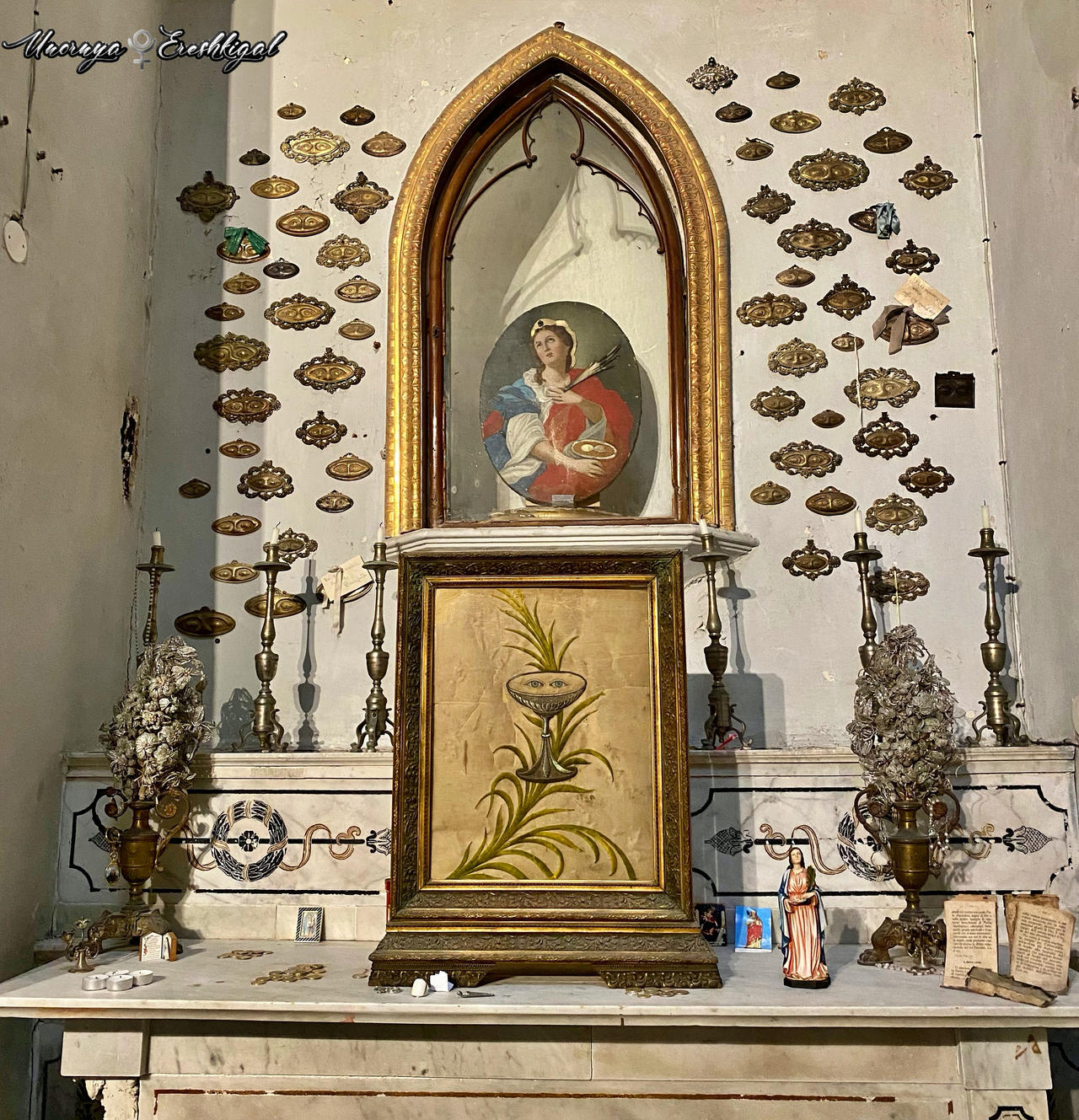
So I would like to tell you about one of these places: the church of Santa Luciella.

It’s a small church in the heart of the ancient city center of Naples, founded in 1327 and located at the top of the alley that in ancient Roman times they called "vicus Cornelianus" that connects San Biagio dei Librai to San Gregorio Armeno.

Over the years, between 1600 and 1700, it passed under the custody of the guild of pipernieri, ancient artists who sculpted hard stones such as Piperno. The processing of this material put the sculptor's eyes at risk, as stone chips could easily spring on his face, consequently the pipernieri began to venerate Saint Lucy, protectress of sight, making the Church of Santa Luciella their place of worship, making an association with the Archconfraternity of the Immaculate Conception to which the Madonna on the high altar of the Church was entrusted.


**Click here to read our post about Saint Lucy.

Inside the church, in the central nave, we find in fact some rather disturbing mannequins, dressed in the clothes worn by the confreres, with the detail of the pointed hood which represented faith, penance for the sins committed but above all the equality between each member who thus became indistinguishable from the others.


Closed to the public after the 1980 earthquake as it was unusable, over time it was forgotten and became a small warehouse for building materials and, subsequently, even a landfill. In 2013 a group of young Neapolitans, specialized in art history, decided to open a foundation called “Respiriamo Arte", thus succeeding in regaining possession of this piece of history, proceeding with the restoration, making it safe and allowing the access to the public again, saving this cultural heritage from ruin.


Below the structure of the church we find a cemetery, a burial place dedicated to members of the Archconfraternity and their families. The method used to treat the bodies of the confreres before the inhumation was called "draining". The corpses were in fact entrusted to the "schiattamuorto", a typical Neapolitan figure representing the gravedigger, who pierced the body in strategic points (in particular the neck, wrists and legs) to ensure that the liquids and gases contained inside could escape more quickly. The body was then placed on large tanks of holy land and left to drain, in fact, thus accelerating the drying and decomposition process. Once ready, the bodies were buried in these tanks for a certain period of time, after which they were exhumed, carefully cleaned the bones which were then deposited in the ossuary below the cemetery (an area which today is accessed through a trap door but which has not yet been explored).

The only part of the body that was preserved in this cemetery was the skull, in Neapolitan called "capuzzella".


The skulls in question were venerated according to the local tradition of the "cult of Anime Pezzentelle", or souls in purgatory.


THE WORSHIP OF ANIME PEZZENTELLE:


This tradition was born in Naples in 1656 during a plague epidemic that devastated the city and killed two thirds of the population. The dead were so numerous that, for reasons of hygiene and protection from contagion, they were placed in mass graves, outside the places of prayer and thus depriving them of their identity. Neapolitan women, moved by pity for the souls of the dead, began to adopt skulls, the capuzzelle.


They went down inside the cemeteries, chose one of the skulls (the part of the body where the soul was thought to reside) and began to take care of them, cleaning and washing them with fresh water that should have given refreshment and relief to the soul of the deceased while they found in the flames of purgatory.


Through these treatments, the soul of the deceased could access heaven more quickly, however, in exchange, the women asked the deceased to intercede for them in order to obtain a grace.


“Pezzentelle”, in fact, derives from the Latin word petere which means “to ask”. When the required miracle was accomplished, the women brought an ex voto and hung it in the burial place as thanks. The ex-votos consisted of metal symbols, especially in silver, which represented the grace obtained: the arrival of a child, the husband's return from the war, the healing of the eyes or the solution of a love problem. Some of these ex-votos are still visible today on the hypogeum walls.


In the early 1900s this cult began to no longer be frowned upon by the Catholic Church, which defined it as a cult bordering on paganism. In fact, according to Catholicism, it is not possible for a believer to intercede with God through the dead (as it’s done with the pagan worship of ancestors) but only through the saints.

Although in 1969 the cult was banned by the Church, Neapolitan women continued the practice, until 1980 when it stopped due to the earthquake.


In addition to the church of Santa Luciella, the main symbolic places of this cult are located in the center of Naples: they are the church of Santa Maria delle anime del Purgatorio in Arco and the Fontanelle Cemetery.


THE SKULL WITH EARS:


Among all the skulls preserved in the underground cemetery of the Church of Santa Luciella we find the famous Skull with Ears.

This skull has the particularity of having two portions of bone that have spread over time, making it appear as if it still had, in fact, the auricles (which in reality it is not possible as the cartilage is one of the parts of the skeleton which degrades faster).

The Skull with ears was the favorite of women who practiced the cult of Anime Pezzentelle, precisely because it was thought that it had the ability to better listen to prayers and requests, acting as a real link between the world of the living and that of the dead. For this reason the skull, dating back to 1600, once exhibited in the crypt has never been touched or moved.


Personally, I find that this macabre tradition typical of the Neapolitan people actually best represents the particular relationship that these people have with the afterlife and with the cult of the dead. A belief that explains to us that we should not fear or show concern towards the dead, but that it is possible to devote ourselves to them gently, preventing them from being forgotten and still keeping them part of the community.

Unornya


martedì 21 giugno 2022

Doon Hill - A Portal Onto The Fairy World


*Per leggere questo articolo in Italiano clicca qui.*


At the Summer Solstice, it is impossible not to mention the paranormal: since the sun is at its peak, during its long journey in the sky, even magic reaches its full power under its golden rays. Throughout Europe there are legends related to the solstice and how natural laws were overturned on this particular day.

As often happens on the occasion of these particular astronomical events, the veil between the worlds becomes thinner and thus communication with the supernatural is favored.

Not only are there particularly suitable periods of the year, but also places of power where other dimensions are more accessible. One of these is Doon Hill, a small corner of peace and lush greenery at the foot of the Scottish Highlands. Although small and probably known only by the most accustomed fans of British folklore, it is the scene of a truly fascinating story about the fair folk.

It happens to be the place where the remains of Reverend Robert Kirk rest, author of "The Secret Commonwealth" and whose fate is still a mystery shrouded in the mists of this magical land.

Kirk was the minister of Aberfoyle, where he remained until his death: he achieved moderate success as the author of the first complete Gaelic translation of the Bible, but his true fame was reached postmortem thanks to the book The Secret Commonwealth - a collection of folklore and legends written between 1691-1692, but published only in 1815.

Kirk, despite his Christian faith, was the holder of what is called "second sight" - which may seem an oxymoron, accustomed as we are to today's conception of Christianity. But we must remember that many Christian customs are imbued with paganism and vice versa, intertwined over the centuries - especially when it comes to rural places, instilled with pre-Christian customs. It was therefore not uncommon to hear of "second sight" in the Scottish Highlands, it was almost routine and prestigious status.


Wandering through the local countryside, gathering evidence of encounters with the fairy folk, he used to frequent nearby Doon Hill - a hill surrounded by woods, not far from his parish. There he said he often encountered ethereal creatures "somewhat of the nature of condensed cloud and best seen in twilight", - who illustrated the habits and customs of their people. They dressed and talked like humans, danced, celebrated, sang but with substantial differences: for example, they fed on the lifeblood (foison) and managed to pass through tiny holes and cracks in the walls. Their homes, where they lived in a society with a well-defined hierarchy, were located underground and often visited this dimension during the nights of Samhain and Beltane - when the veil between worlds was thinnest. There were also differences in what we can call "moral": the fairies were neither good nor bad, sometimes they made themselves useful to others by giving advice on how to fix tools or warning of imminent dangers, sometimes instead they kidnapped young mothers to breastfeed their children, they seduced humans and / or stole their infants - think of the famous changelings for example.

They had nothing to do with the sweetened version that we imagine today: according to legends, they are thin and shiny beings - similar to the Elves described by Tolkien, which have roots in Norse mythology.

The Norse and the Anglo Saxons, indeed, called them alfar (elves). 

In Ireland they were known as sidhe, while in Scotland as sith - meant as inhabitants of the Sitheans, mounds considered portals to the other world, while in Wales they were called ellyllon (shining beings). Today's connotation of fairies derives from the French fée and then Englishised into fairy.

Those who met them, during their crepuscular celebrations, were overwhelmed by an irrepressible desire to dance and follow the procession - often ending up in their world and then being unable to return. Only the purest of heart and most gifted in the arts were able to receive gifts and return to this dimension.

Returning to our Robert Kirk, one day he was mysteriously found dead at the top of the hill. The reason for his death is still a mystery now ... it may have been an illness, maybe he fell into the wrath of the fairy people for having revealed their secrets, some say that the body was simply a simulacrum and the real Robert Kirk was transported to the kingdom of fairies.

Whatever the truth, his body (real or not) is buried at Aberfoyle Cemetery, while Doon Hill can be visited via a peaceful and relaxing path - lined with trees covered with ribbons, prayers, flowers and offerings. Pulsating memory of a folklore that was and still lives in the hearts of those who visit the hill, perhaps hoping to meet some supernatural being.

Whatever you do for the solstice, be careful.

The veil becomes thin, and with it the visits on this plane more frequent.


♃Ludna

mercoledì 1 dicembre 2021

Mari Lwyd - A Welsh Christmas Spirit

December has arrived, and with it the Yuletide.

Whether you were in ancient Rome celebrating Saturnalia, or in the sacred stone circle of Stonehenge welcoming the newborn sun on the horizon, or around a fire drinking mead, telling stories during the longest night in Scandinavia ; the theme was always the same: the triumph of sacred light over darkness.


What we have been taught as children, if you too grew up in a predominantly Christian community, is the good-natured and sugary version of Christmas: lights, gifts, songs around the tree, laughter, moments of celebration in the family.


But as we well know, the Christian sweetened versions are reinterpretations of ancient cults - which are joyful, but also include a part of shadow that is often omitted (and which is essential, to fully understand the duality of existence).


*** Click here to read our article on the Winter Solstice.


If in the past few years we have taken you to the Alpine valleys with the Krampus and between Italy and Scandinavia with Saint Lucy, this year instead we are taking you to the greenest of Wales.


Although it has been part of the United Kingdom for hundreds of years and most of the population now speaks English, Wales can be defined as a true Celtic nation - with a well-defined cultural identity, which has survived centuries of British hegemony (in turn a wounded product of the Roman invasion in the first place, and then of the Saxon invasion and Christianisation later).


Personally one of the countries that I find most imbued with magic, we could discuss for hours about its uniqueness and the beautiful natural landscape that characterises it, but today we will talk about a particular Christmas custom: the Mari Lwyd.


Originally from South Wales, it is a tradition that was at risk of disappearing during the last century but which fortunately has taken hold again thanks to a renewed popularity, certainly thanks to its suggestive and particular figure (and perhaps also of social media?). 

In fact I think it is difficult to forget, once seen in first person: the costume consists of a horse skull, supported by a pole and decorated with bows and festive motifs - veiled with a cloak, usually white, hiding the individual who personifies the Mari .


The Mari Lwyd is mentioned for the first time in 1798, in J.Evans' book "A Tour through Part of North Wales, in the year 1798, and at Other Times" but it was immediately clear that it was a reminiscence of older customs - starting with the British tradition of wassailing, of which the mare is perhaps the most extravagant version.


During the Middle Ages, especially in the southern part of today's United Kingdom, it was traditional to observe the Twelve Nights of Christmas; during which it was customary to drink spiced alcoholic beverages based on beer or cider, and wish the participants good health.In fact, the word "wassail" derives from Old Norse ves heill, which in turn was translated into archaic English wes hál (to good health).


On the Twelfth Night, people were knocking from house to house - singing and offering hot and aromatic drinks in exchange for gifts. Custom would like the feudal lords to offer blessings and food to the villagers, who presented themselves at the door of the manor singing litanies. If all this reminds you of the Victorian custom of "carolling" and today's Christmas carols, you guessed it right: they come from here.


The origins of wassailing were not always of good-natured origin, some like the "first footing" had more of a trickster nature - similar to the famous "trick or treat" typical of Halloween. The Mari Lwyd belongs to the latter category.


During the night, the mare is escorted from door to door by her human companions - who challenge the host to a pwngco or rhyming contest (often quite rude!), making excuses as to why Mari cannot enter into the house. Once the motivations, obviously fictitious, are exhausted, the inhabitant is forced to let in, by offering libations, this Christmas spirit which will run around the house, creating havoc and "scaring" the children; bringing with it a good omen for the coming year.


But who is the Mari Lwyd?


Its origins are not entirely clear and have perhaps been lost over the centuries, however there are two schools of thought about it.


The first connects her to the nativity, placing Mari Lwyd as a translation of Gray Mary (or Holy Mary): according to an old legend, a pregnant mare was sent out of the stable to make room for the Madonna pregnant with the Baby Jesus. According to the legend, she is still roaming the earth for a warm place where she can give birth to her foal.

Another version of the Christian origin of the festival associates it with the medieval Feast of the Ass - where the mare is identified as the donkey that took the Virgin Mary in flight to Bethlehem to give birth to the Baby Jesus.


If you are accustomed to pagan traditions, you will surely have noticed the running theme: that of the shamanic flight and the Wild Hunt, typical of many celebrations of the period, I refer you again to the links above to deepen this topic. Even the legend of the stable has a very sinister and symbolic theme: that of a pagan divinity, supplanted by the arrival of Christianity.

In fact, now we come to the second version of Mari Lwyd's origin, the most accredited (despite the lack of verified historical sources) and the one we like even more!


Another plausible translation of the name is "Gray Mare" (gray mare), from the assonance with the English word "mare" and "lwyd", which in Welsh means gray. This would connect it with the enormous importance that horses held in Celtic and British culture, especially white horses - true messengers from the Otherworld (Rhiannon rode a white horse, for example). This version is further strengthened by the fact that the Mari tradition shares similarities with other British Isles traditions - to name a few, are the Hoodening from Kent or the Old Tup celebrated between Derbyshire and Yorkshire, The Broad or the Old Horse of Northern England to the neighbouring Ireland with the tradition of the Láir Bhán (white mare) and Laare Vane of the Isle of Man.


Uffington White Horse - Dating back to the Bronze Age (Oxfordshire)


It is not difficult to see the reminiscences of a pagan cult, finding oneself in front of the white skull of a horse on the threshold of the front door, in exchange for auspicious offers during the longest and darkest nights of the year. It is a common theme in many traditions of the Northern Hemisphere where winter is exorcised, a symbol of physical Death and spiritual introspection, inviting Her to the table and offering Her gifts in exchange for another lucky year in this plane of existence. And not even Christianisation and centuries of occupation have managed to eradicate this tradition so alive and so ancient and rooted in the Celtic heart of Wales.


"Mari Lwyd, Horse of Frost, Star-horse, and White Horse of the Sea, is

carried to us.

The Dead return.

Those Exiles carry her, they who seem holy and have put on corruption,

they who seem corrupt and have put on holiness.

They strain against the door.

They strain towards the fire which fosters and warms the Living"

VERNON WATKINS, THE BALLAD OF THE MARI LWYD


♃Ludna

Clicca qui per leggere questo post in Italiano

domenica 13 dicembre 2020

Saint Lucy - The Return of the Sacred Light

When I think of the Christmases of my childhood, I would be hypocritical to say that I think of the figure of Santa Claus. No, that came later - when I was then a little less susceptible to the magical charm of the holiday season. I don't even think of the Epiphany or the Three Kings, deeply felt traditions in Southern Europe but not in the heart of North East Italy…Yule, the winter solstice, was a rather recent discovery for me.

Being Venetian, born and raised in Verona, I can't help but associate this period of the year with the 13th December. A date that will make me think forever of childish enthusiasm, bated breath, going to bed early with the hope of making the morning arrive in the blink of an eye... The next day, in fact, was not just any day: finally the year-long wait ended and I would find the gifts brought in the night by Saint Lucy.

According to the Veronese custom, the Saint would pass from house to house between the 12th and the 13th December, riding a donkey, leaving gifts and sweets for the children; who went to bed leaving offerings and food for her and her mount.

Typically, she is depicted as a blind woman, dressed in white and wearing a crown of candles as a headdress.

The interesting thing is that Saint Lucia is not celebrated only in Veneto, but in various areas of Italy, Croatia, Hungary and even up to Scandinavia - a land that is so distant, both geographically and culturally, from the origins of the celebration. 


But let's go in order, who was Saint Lucy?

Lucy (or Lucia, in Italian), in reality, is of Sicilian origin - where she is still celebrated today with long processions, lighting of candles and abstention from the consumption of wheat on December 13th. This tradition has ancient origins, memories of a terrible famine that struck Sicily and, during the day dedicated to the saint, it is said that a ship loaded with wheat appeared on its shores - finally feeding the exhausted population. Hence the figure of Saint Lucy as the bearer of gifts… At least, according to the Catholic Church.

Although there are no confirmed historical sources, Lucy was born in Syracuse in the year 283 AD - from a wealthy family of Christian faith. Devoted only to God, she did not want to submit to an arranged marriage in order to follow her religious vocation.

Legend has it that she brought food to persecuted Christians, hidden in the absolute darkness of the catacombs, illuminating her path with the dim light of candles - which became one of the symbols par excellence of the saint.

She died in 304 AD, executed thanks to the ferocious persecution against Christians perpetrated under the emperor Diocletian - denounced by her own husband, who did not want to accept her refusal. At first, guards tried to set her on fire, but her strong faith in God made her unburnable so she was then killed with a dagger and eye gouged - taking away her beautiful eyes.

As you can easily expect, the feast of Saint Lucy is nothing more than another pagan holiday that has been Christianized over the centuries. The name itself, Lucia, means "light" from the Latin "lux": in fact, the return of light is the main theme of this holiday (remember the candles?), like so many solstice festivals celebrated in this period.

The symbols of the saint themselves are actually solar symbols: the crown of candles, the blond hair with which she is usually represented, the eyes on the tray, the ears of wheat (later wisely replaced by the palm grove in her iconography, symbol of martyrdom), the sword… In the northern Italian tradition, she is represented by riding a donkey.

Another recurring theme in the myths of Santa Claus and the Befana, symbolizing the shamanic flight and the Wild Hunt.


*** Click here to read our article on Krampus, the Wild Hunt and other winter traditions.

Not surprisingly, before the introduction of the Gregorian calendar in 1582, the Winter Solstice fell precisely on December 13: even now, in fact, there are several proverbs linked to the days that gradually become longer, after the long darkness.

I leave you the Veronese version below:

De Santa Lussia na ponta de ucia,

De Nadal el passo de on gal,

De l'Epifania el passo de na stria,

De Sant'Antonio el passo de un demonio,

De San Bastian un'ora e on passo de can.


On Saint Lucy (13th December), the point of a needle

At Christmas (25th December), the step of a rooster,

On the Epiphany (6th January), the step of a witch

On Saint Anthony (17th January), the devil's step

On Saint Sebastian (20th January), one hour and one dog step

The Sacred Light of Northern Europe

It is not clear how an Italian saint is venerated in Scandinavia, where her celebration is even
more popular than in her native country. The cult is thought to have arrived during the Middle Ages, carried by Catholic missionaries; then being syncretised with local customs.

It seems that it was precisely the return of the Sacred Light that made the saint so loved in Scandinavia, where the evangelization came much later than the rest of Europe: it is not so much the figure of Lucy that is celebrated, but the meaning behind it.

In the heart of winter, people could only take advantage of a few hours of light before the cold darkness fell again; the winter solstice was therefore eagerly awaited in order to finally be able to return to the comfort of the light and warmth of the coming season.

Traditionally, on the night of December the 12th, the vigil (Lussevaka) was celebrated: during the then longest night, the Earth was believed to be infested with hordes of evil spirits; it was customary to stay awake until dawn, safe in the homes lit by many candles, to make sure that none of them crossed the threshold.

On the morning of December 13th, dawn would then come (in this case, symbolised by Lucy), dispelling the darkness and bringing relief and awareness that the longest night had finally come to an end.

Nowadays, tradition has it that a member of the family (usually the eldest daughter), impersonates the figure of the saint and takes care of preparing typical sweets and hot drinks to be served to begin the celebration of Lucia Dag.

And on this day, wherever you are, I wish you a peaceful celebration: may Lucy bring you light in a world that at the moment needs to find its way again, in this long winter. A light of comfort, joy and carefree laughter - like happy memories of our childhood.

I, of course, will spend the day wrapped in the most beautiful memories and greeting the return of the sun.

Bright Blessings.

♃Ludna
Clicca qui per leggere questo post in Italiano