Visualizzazione post con etichetta Deities. Mostra tutti i post

mercoledì 1 dicembre 2021

Mari Lwyd - A Welsh Christmas Spirit

December has arrived, and with it the Yuletide.

Whether you were in ancient Rome celebrating Saturnalia, or in the sacred stone circle of Stonehenge welcoming the newborn sun on the horizon, or around a fire drinking mead, telling stories during the longest night in Scandinavia ; the theme was always the same: the triumph of sacred light over darkness.


What we have been taught as children, if you too grew up in a predominantly Christian community, is the good-natured and sugary version of Christmas: lights, gifts, songs around the tree, laughter, moments of celebration in the family.


But as we well know, the Christian sweetened versions are reinterpretations of ancient cults - which are joyful, but also include a part of shadow that is often omitted (and which is essential, to fully understand the duality of existence).


*** Click here to read our article on the Winter Solstice.


If in the past few years we have taken you to the Alpine valleys with the Krampus and between Italy and Scandinavia with Saint Lucy, this year instead we are taking you to the greenest of Wales.


Although it has been part of the United Kingdom for hundreds of years and most of the population now speaks English, Wales can be defined as a true Celtic nation - with a well-defined cultural identity, which has survived centuries of British hegemony (in turn a wounded product of the Roman invasion in the first place, and then of the Saxon invasion and Christianisation later).


Personally one of the countries that I find most imbued with magic, we could discuss for hours about its uniqueness and the beautiful natural landscape that characterises it, but today we will talk about a particular Christmas custom: the Mari Lwyd.


Originally from South Wales, it is a tradition that was at risk of disappearing during the last century but which fortunately has taken hold again thanks to a renewed popularity, certainly thanks to its suggestive and particular figure (and perhaps also of social media?). 

In fact I think it is difficult to forget, once seen in first person: the costume consists of a horse skull, supported by a pole and decorated with bows and festive motifs - veiled with a cloak, usually white, hiding the individual who personifies the Mari .


The Mari Lwyd is mentioned for the first time in 1798, in J.Evans' book "A Tour through Part of North Wales, in the year 1798, and at Other Times" but it was immediately clear that it was a reminiscence of older customs - starting with the British tradition of wassailing, of which the mare is perhaps the most extravagant version.


During the Middle Ages, especially in the southern part of today's United Kingdom, it was traditional to observe the Twelve Nights of Christmas; during which it was customary to drink spiced alcoholic beverages based on beer or cider, and wish the participants good health.In fact, the word "wassail" derives from Old Norse ves heill, which in turn was translated into archaic English wes hál (to good health).


On the Twelfth Night, people were knocking from house to house - singing and offering hot and aromatic drinks in exchange for gifts. Custom would like the feudal lords to offer blessings and food to the villagers, who presented themselves at the door of the manor singing litanies. If all this reminds you of the Victorian custom of "carolling" and today's Christmas carols, you guessed it right: they come from here.


The origins of wassailing were not always of good-natured origin, some like the "first footing" had more of a trickster nature - similar to the famous "trick or treat" typical of Halloween. The Mari Lwyd belongs to the latter category.


During the night, the mare is escorted from door to door by her human companions - who challenge the host to a pwngco or rhyming contest (often quite rude!), making excuses as to why Mari cannot enter into the house. Once the motivations, obviously fictitious, are exhausted, the inhabitant is forced to let in, by offering libations, this Christmas spirit which will run around the house, creating havoc and "scaring" the children; bringing with it a good omen for the coming year.


But who is the Mari Lwyd?


Its origins are not entirely clear and have perhaps been lost over the centuries, however there are two schools of thought about it.


The first connects her to the nativity, placing Mari Lwyd as a translation of Gray Mary (or Holy Mary): according to an old legend, a pregnant mare was sent out of the stable to make room for the Madonna pregnant with the Baby Jesus. According to the legend, she is still roaming the earth for a warm place where she can give birth to her foal.

Another version of the Christian origin of the festival associates it with the medieval Feast of the Ass - where the mare is identified as the donkey that took the Virgin Mary in flight to Bethlehem to give birth to the Baby Jesus.


If you are accustomed to pagan traditions, you will surely have noticed the running theme: that of the shamanic flight and the Wild Hunt, typical of many celebrations of the period, I refer you again to the links above to deepen this topic. Even the legend of the stable has a very sinister and symbolic theme: that of a pagan divinity, supplanted by the arrival of Christianity.

In fact, now we come to the second version of Mari Lwyd's origin, the most accredited (despite the lack of verified historical sources) and the one we like even more!


Another plausible translation of the name is "Gray Mare" (gray mare), from the assonance with the English word "mare" and "lwyd", which in Welsh means gray. This would connect it with the enormous importance that horses held in Celtic and British culture, especially white horses - true messengers from the Otherworld (Rhiannon rode a white horse, for example). This version is further strengthened by the fact that the Mari tradition shares similarities with other British Isles traditions - to name a few, are the Hoodening from Kent or the Old Tup celebrated between Derbyshire and Yorkshire, The Broad or the Old Horse of Northern England to the neighbouring Ireland with the tradition of the Láir Bhán (white mare) and Laare Vane of the Isle of Man.


Uffington White Horse - Dating back to the Bronze Age (Oxfordshire)


It is not difficult to see the reminiscences of a pagan cult, finding oneself in front of the white skull of a horse on the threshold of the front door, in exchange for auspicious offers during the longest and darkest nights of the year. It is a common theme in many traditions of the Northern Hemisphere where winter is exorcised, a symbol of physical Death and spiritual introspection, inviting Her to the table and offering Her gifts in exchange for another lucky year in this plane of existence. And not even Christianisation and centuries of occupation have managed to eradicate this tradition so alive and so ancient and rooted in the Celtic heart of Wales.


"Mari Lwyd, Horse of Frost, Star-horse, and White Horse of the Sea, is

carried to us.

The Dead return.

Those Exiles carry her, they who seem holy and have put on corruption,

they who seem corrupt and have put on holiness.

They strain against the door.

They strain towards the fire which fosters and warms the Living"

VERNON WATKINS, THE BALLAD OF THE MARI LWYD


♃Ludna

Clicca qui per leggere questo post in Italiano

domenica 13 dicembre 2020

Saint Lucy - The Return of the Sacred Light

When I think of the Christmases of my childhood, I would be hypocritical to say that I think of the figure of Santa Claus. No, that came later - when I was then a little less susceptible to the magical charm of the holiday season. I don't even think of the Epiphany or the Three Kings, deeply felt traditions in Southern Europe but not in the heart of North East Italy…Yule, the winter solstice, was a rather recent discovery for me.

Being Venetian, born and raised in Verona, I can't help but associate this period of the year with the 13th December. A date that will make me think forever of childish enthusiasm, bated breath, going to bed early with the hope of making the morning arrive in the blink of an eye... The next day, in fact, was not just any day: finally the year-long wait ended and I would find the gifts brought in the night by Saint Lucy.

According to the Veronese custom, the Saint would pass from house to house between the 12th and the 13th December, riding a donkey, leaving gifts and sweets for the children; who went to bed leaving offerings and food for her and her mount.

Typically, she is depicted as a blind woman, dressed in white and wearing a crown of candles as a headdress.

The interesting thing is that Saint Lucia is not celebrated only in Veneto, but in various areas of Italy, Croatia, Hungary and even up to Scandinavia - a land that is so distant, both geographically and culturally, from the origins of the celebration. 


But let's go in order, who was Saint Lucy?

Lucy (or Lucia, in Italian), in reality, is of Sicilian origin - where she is still celebrated today with long processions, lighting of candles and abstention from the consumption of wheat on December 13th. This tradition has ancient origins, memories of a terrible famine that struck Sicily and, during the day dedicated to the saint, it is said that a ship loaded with wheat appeared on its shores - finally feeding the exhausted population. Hence the figure of Saint Lucy as the bearer of gifts… At least, according to the Catholic Church.

Although there are no confirmed historical sources, Lucy was born in Syracuse in the year 283 AD - from a wealthy family of Christian faith. Devoted only to God, she did not want to submit to an arranged marriage in order to follow her religious vocation.

Legend has it that she brought food to persecuted Christians, hidden in the absolute darkness of the catacombs, illuminating her path with the dim light of candles - which became one of the symbols par excellence of the saint.

She died in 304 AD, executed thanks to the ferocious persecution against Christians perpetrated under the emperor Diocletian - denounced by her own husband, who did not want to accept her refusal. At first, guards tried to set her on fire, but her strong faith in God made her unburnable so she was then killed with a dagger and eye gouged - taking away her beautiful eyes.

As you can easily expect, the feast of Saint Lucy is nothing more than another pagan holiday that has been Christianized over the centuries. The name itself, Lucia, means "light" from the Latin "lux": in fact, the return of light is the main theme of this holiday (remember the candles?), like so many solstice festivals celebrated in this period.

The symbols of the saint themselves are actually solar symbols: the crown of candles, the blond hair with which she is usually represented, the eyes on the tray, the ears of wheat (later wisely replaced by the palm grove in her iconography, symbol of martyrdom), the sword… In the northern Italian tradition, she is represented by riding a donkey.

Another recurring theme in the myths of Santa Claus and the Befana, symbolizing the shamanic flight and the Wild Hunt.


*** Click here to read our article on Krampus, the Wild Hunt and other winter traditions.

Not surprisingly, before the introduction of the Gregorian calendar in 1582, the Winter Solstice fell precisely on December 13: even now, in fact, there are several proverbs linked to the days that gradually become longer, after the long darkness.

I leave you the Veronese version below:

De Santa Lussia na ponta de ucia,

De Nadal el passo de on gal,

De l'Epifania el passo de na stria,

De Sant'Antonio el passo de un demonio,

De San Bastian un'ora e on passo de can.


On Saint Lucy (13th December), the point of a needle

At Christmas (25th December), the step of a rooster,

On the Epiphany (6th January), the step of a witch

On Saint Anthony (17th January), the devil's step

On Saint Sebastian (20th January), one hour and one dog step

The Sacred Light of Northern Europe

It is not clear how an Italian saint is venerated in Scandinavia, where her celebration is even
more popular than in her native country. The cult is thought to have arrived during the Middle Ages, carried by Catholic missionaries; then being syncretised with local customs.

It seems that it was precisely the return of the Sacred Light that made the saint so loved in Scandinavia, where the evangelization came much later than the rest of Europe: it is not so much the figure of Lucy that is celebrated, but the meaning behind it.

In the heart of winter, people could only take advantage of a few hours of light before the cold darkness fell again; the winter solstice was therefore eagerly awaited in order to finally be able to return to the comfort of the light and warmth of the coming season.

Traditionally, on the night of December the 12th, the vigil (Lussevaka) was celebrated: during the then longest night, the Earth was believed to be infested with hordes of evil spirits; it was customary to stay awake until dawn, safe in the homes lit by many candles, to make sure that none of them crossed the threshold.

On the morning of December 13th, dawn would then come (in this case, symbolised by Lucy), dispelling the darkness and bringing relief and awareness that the longest night had finally come to an end.

Nowadays, tradition has it that a member of the family (usually the eldest daughter), impersonates the figure of the saint and takes care of preparing typical sweets and hot drinks to be served to begin the celebration of Lucia Dag.

And on this day, wherever you are, I wish you a peaceful celebration: may Lucy bring you light in a world that at the moment needs to find its way again, in this long winter. A light of comfort, joy and carefree laughter - like happy memories of our childhood.

I, of course, will spend the day wrapped in the most beautiful memories and greeting the return of the sun.

Bright Blessings.

♃Ludna
Clicca qui per leggere questo post in Italiano


sabato 15 giugno 2019

Aquae Sulis - The Celtic heart of Roman Britain


In Southern England we can find a real historical and architectural jewel, set in the green English countryside: the town of Bath. We are in Somerset - a region that, as we have already seen speaking of Glastonbury, stands out for the number of sites of esoteric interest on its territory.

The name of Bath derives, of course, from "baths", in fact this place was an important thermal establishment during the Roman occupation. But it would be simplistic to classify it only as such, as it was also a place of worship for the Celts in the first place and for the Romans later.

The sacred waters, considered miraculous, originate from the subsoil: the millenary rains, poured over the centuries on the Mendip Hills, penetrated into the calcareous layers of the soil where, in depth, they reached a temperature of about 96 ° C. The water pressure, overheated, brought the underground watercourse back to the surface, giving rise to its famous source: a natural pool, emerald in color and with crimson grinding of iron, wrapped in the fumes of steam raised in the icy winter air ... There is no doubt as to why the people of that time considered this wonder to be the work of the Gods.

Studies show that the source has been in use for at least 10,000 years, but we have the first concrete evidence with the arrival of the Celts in Britain in 700 BC, who circumscribed the perimeter with wooden structures for ritual purposes.

They believed that this magical place, with its healing properties, was the work of the Goddess Sul - a Celtic goddess patron of medicine, healing and fertility. Coins were found on the bottom of the spring, proving the theory that the population used the body of water as a channel of communication with the divine, leaving offers in the hope of gaining her favour.

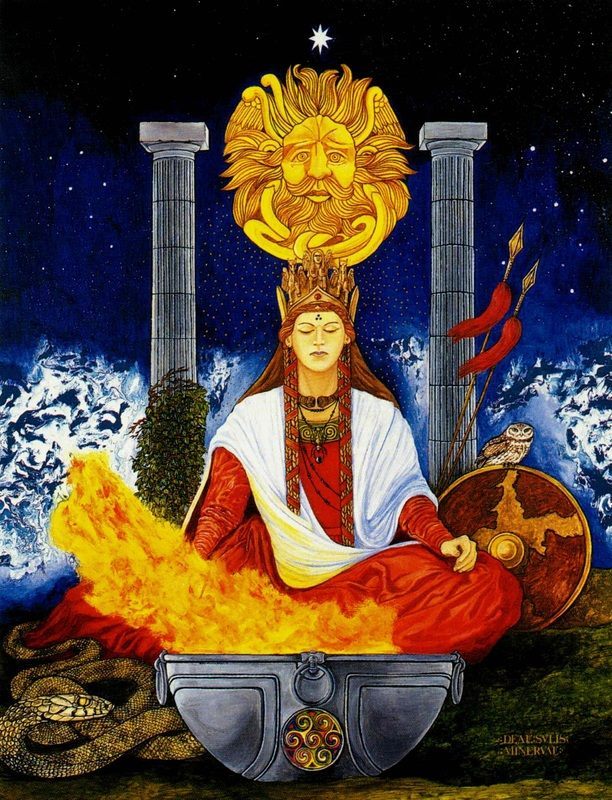
THE GODDESS SULIS-MINERVA

Sul or Sulis was a deity worshiped in the neighboring areas of this magical source. Unlike today's widespread neo-pagan concept of female lunar deity, she is a solar goddess.

The etymology of her name is not entirely clear, the most accepted theory is that the word comes from the Proto-Celtic sūli: one of the many suffixes for the word "sun", of Indo-European derivation (see ηέλιος "elios" in Greek, "sūryah" in Sanskrit, "suhlio" in Proto-Indo-European). From this root, the word "súil" (eye) in Irish Archaic and "licat" would also derive, meaning both "eye" and "source" in Archaic Welsh.


As mentioned above, she is mainly associated with healing and fertility but also with clairvoyance; like many other goddesses she has an ambivalent nature.

Sulis was often invoked to protect those who suffered wrong and to curse the perpretants, as a guarantor of justice.

In the museum of Roman baths we can admire 130 pewter tablets, on which there are inscriptions of curses and invocations to the goddess to get personal vendettas. Normally it was a question of profit for small thefts, often occurring inside the establishment: small sums of money, clothes or personal items. These tablets, moreover, have an inestimable historical value, being probably among the only written examples of the Celtic language.

The Romans, who arrived in Somerset in 43 AD during their British occupation campaign, immediately recognized the sacredness of the place. Despite their frenzied thirst for expanding the Empire, they used to respect local deities - often syncretizing them with their gods (Interpretatio romana).

Learning soon about the benevolent nature and the strong sense of justice of Sulis, it was not difficult to associate her with Minerva - the beloved goddess patron of reason, wisdom and heroic virtues, as well as protector of artisans. Her cult was widespread in the Empire, testimonies of her devotion were found in all the Roman provinces and was often assimilated to other deities such as the Celtic Brigantia or the kemetic Neith.

Sulis-Minerva, with her miraculous healing qualities, also became popular among Roman soldiers: many veterans of war, afflicted by old wounds and aches, relied on her care and her spring to receive the benefits. During the military campaign, artisans and merchants moved to expand their businesses in these new provinces, while some aoldiers decided to start a new life at Aquae Sulis - thus turning this natural temple into a thriving merchant centre.

The fervent economy and the growing popularity of the cult of the goddess, led to the decision to honour the sacred source by building one of the most important spas and places of worship in the British provinces.

THE TEMPLE AND THE BATHS

To transform a wonderful natural source into an equally astonishing architectural work, it took the expert Roman engineering. It was an ambitious project: the source was the realm of the severe goddess Sulis and also a fragile environment, being a geothermal location and therefore required a more complex hydraulics.

Wood and stone were transported along the banks of the Avon river, while clay tiles were imported from Wiltshire, experts rushed from the imperial provinces to watch the work; finished in 75 d.c. By the year 100 AD Bath was a lively commercial, recreational and religious centre - considered one of the "most sophisticated cities of Roman Britain".

The baths became so popular that pilgrims regularly visited the town to honour Sulis Minerva and take advantage of the thermal waters; the constant flow of wayfarers led to a fervent building expansion, further transforming the thermal complex.

The original woodland clearing, venerated by the Celts, was then enclosed in a barrel-faced structure, dimly lit by candlelight and surrounded by columns and statues - enriching the mystical atmosphere.

The Temple, built adjacent to the spring, was built in a classical style (unusual, in Roman Britain): inside was the statue of the goddess, illuminated by the sacred fire. The complex stood on a podium two meters high from the mosaic paved area; to surround the whole, there was a colonnaded ambulatory in Corinthian style.

With the spreading of Christianity in Europe, this imposing place of pray fell into disuse - until the eventual collapse of the building. Fortunately, in addition to traces of  the original structure, invaluable archaeological finds were found: silent witnesses of a distant, forgotten era.

THE GODDESS STATUE

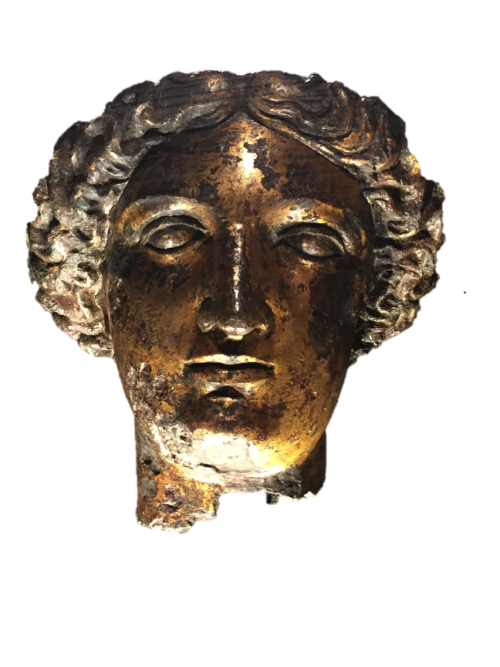
The bronze head of Sulis Minerva is one of the most famous finds in Roman Britain: its discovery, in 1727, suggested that Bath was not an archaeological site like any other.


Probably it was part of the statue that resided inside the Temple, towering above the sacrificial altar.
Considering the size of the head, we can only imagine the authority that could inspire Sulis Minerva, illuminated only by the meandering flames of the sacred brazier. Small holes in the hair reveal that there was probably a Corinthian helmet fixed on the head, unfortunately lost in the mists of time.

THE GORGON’S HEAD

The temple had numerous unusual features for Roman architecture: among these, the elaborate pediment with a Gorgon's head in the center, supported by two winged creatures in a clipeus, was prominent. Supported by four, 15-meter tall columns, it must have been a very powerful vision for those approaching the temple.


The pediment boasts several symbols: in the corners there are tritons, half-fish creatures and half-men servants of the god Neptune. At the bottom left there is a dolphin-shaped helmet, while in the right corner we have an owl (symbol of Minerva).

Various controversies have arisen to determine the identity of the Gorgon: in fact, despite having wings over the ears and snakes entwined in the beard, the depicted face is masculine, while, according to tradition, the Gorgon was a female creature killed by the hero Perseus with the help of Athena (the Greek counterpart of Minerva). Once defeated, Perseus gave her head to the goddess, who exposed her on her breastplate - what better symbolism, for a temple dedicated to the Roman Minerva?

Another theory suggests that the Gorgon is instead a representation of the god Oceanus,
the titan master of the waters. The cult of the Ocean was widespread in Roman Britain: legionaries obviously had to cross the English Channel to land in the present-day United Kingdom, so it was in their interest to grace the god. Emperor Severus even minted coins with the head of Oceanus on one side, the head of Neptune on the other; while on the bridges there were sometimes sacrificial altars dedicated to these two deities - to pay a pledge, in exchange for their protection near bodies of water.

One of the symbols associated with the Titan was in fact the dolphins, found also on the pediment.

Another theory instead associates this mysterious figure with a solar Celtic divinity, Belenos: however unlikely it may seem that the Romans funded a similar work, the pediment author was a Gaul and could have created a tribute to his patron deity.

We will probably never know the truth behind this enigmatic figure, we can only limit ourselves to immerse in the sacred atmosphere of Aquae Sulis, marveling at this architectural masterpiece, reverberations of time and space that reached us over the centuries.


♃Ludna
Clicca qui per leggere questo post in Italiano.


venerdì 21 dicembre 2018

Yule - The Magic of Winter

During my teenage years, I found Christmas an essentially commercial, empty festivity: a façade of joy and dazzling lights on a crumbling building, dark and cold. The hyperbole of our society, where everything looks beautiful thanks to Instagram filters and by filling our inner emptiness with shopping carts full of consumer goods.

At an older age, however, I found myself appreciating more this celebration, having learned the arcane meaning behind it: the Winter Solstice. The triumph of the Sun over the darkness, celebrated for millennia by many peoples.

And it is there that the songs in the streets and shops, the lights in the windows and the glittering decorations on the tree echo with ancient laughter, joys and gifts exchanged by the light of fires lit during the long night.


Astronomically speaking, the winter solstice represents the moment in which the Sun reaches, in its apparent motion, the lowest point on the horizon, and then begins to rise in its path up to the highest point (the summer solstice) . This lack of light and warmth, led to the birth of many legends and festivities, linked to this suggestive moment of the year.

Two main themes recur: the darkness, the real heart of the cold season, often represented as an elderly figure, and the light, reborn after the longest night.

For the Neopagans, the solstice represents Yule, the first sabbatical feast of the year: the Goddess gives life to the God, the child Sun, who carries with him the promise of a warm spring. The name of the festival derives from the feast of Juul, a blot celebrated in pre-Christian Scandinavia. It was a moment of joy, of recollection but also of sacrifice: we must remember that, while today we are accustomed to our weekly shopping at the supermarket downtown, winter represented a season of famine for our ancestors. It was customary to sacrifice the flocks to the gods, thus ingratiating their favour, eating the meat with their loved ones and avoiding a death of hardships to livestock during the harsh winter.

From Northern Europe, we have inherited some of today's traditions such as the Yule log and the Christmas tree, which is spontaneously associated with Yggdrasil, the axis mundi.

 According to the legend, St. Boniface, who christianised Saxony and Friesland, on his way back to Rome, had a large oak tree cut, a tree sacred to the local pagans.
From the roots of the oak, a fir tree was born magically and St. Boniface interpreted this event as a divine sign, representing the goodness of Christianity.
However evergreen trees were known, in the pagan tradition, to bring prosperity and resistance during the winter season and for this they were taken to homes and hung to attract good luck.
It goes without saying that a sign of this kind should be interpreted as paganism (the fir tree) resisting the obscurantism of Christianity (the oak, which in the cold season loses its leaves).
The evergreens were also the sacred trees to the god Baal, a solar deity

Another tradition linked to evergreens is the "Yule log", known also as the "Christmas log". Usually it is a very large log, lit in the fireplace on the evening of Christmas Eve and meant to be burn up to the Epiphany.
By tradition, it helps driving away the evil spirits that roam the earth during the Solstice and serve to "strengthen" the life force of the Sun, which at this time of the year is weaker.

Even the famous figure of Santa Claus is of Scandinavian derivation: before being associated with the chubby bearded man we all know, he was portrayed as a very tall old man, dressed in black on horseback. A figure far from reassuring and good-natured, compared to that on the bottle of Coca Cola.
This spectral figure was associated with Odin and his horse.
During the longest night of the year, Odin kept a hunt (the Wild Hunt) along with other deities and spirits. The children in the villages used to put their boots out of the door, full of vegetables to feed the hunters' horses; in return they found the shoes full of gifts.

A somewhat more modern conception of Santa Claus, which helped to spread the tradition all over the world, is the one described in Clement C. Moore's poem "The Night before Christmas", published for the first time in 1823.

Inspired by various legends related to Santa Claus, Moore wrote this poem in which Santa Claus is described but as a small elf, fast and old, so minute to enter the houses through the chimneys, which he reached by flying over the roofs in his small sled , towed by eight reindeer. This little elf is called St. Nick.
For fans of ancient Anglo-Saxon traditions, the approach of St. Nick with Old Nick, one of the many names used to refer to the Devil, will not have escaped.

Similar concepts, put in the shade by the now-ubiquitous Santa, are found in various interpretations around Europe (see Befana, St Lucy, St Nick and the Three Kings just to name a few).


*** Click here to read our article on Krampus, the Wild Hunt and other winter traditions.

The rebirth of the sun during the winter solstice period is a theme common to many pagan traditions, so much so that the emperor Aureliano established on December 25th "dies natalis Solis invicti", thus giving to all the different cultures present in the Empire Roman a common day to celebrate the glory of the Sun.

Also in this period, in Ancient Rome, the Saturnalia were celebrated between 17th and 23rd December. As it can be easily deduced from the name, they were festivals in honour of the god Saturn: it was custom, during these days, to exchange small gifts and illuminate the cities by day - other traditions certainly familiar to us. It was believed that the old god, out of the Underworld, was hovering over our dimensional plane, bringing with him the spirits of the deads; in order to make them find the road to the Underworld again, sacrifices were offered, songs were sung, fires were lit and people dressed up.

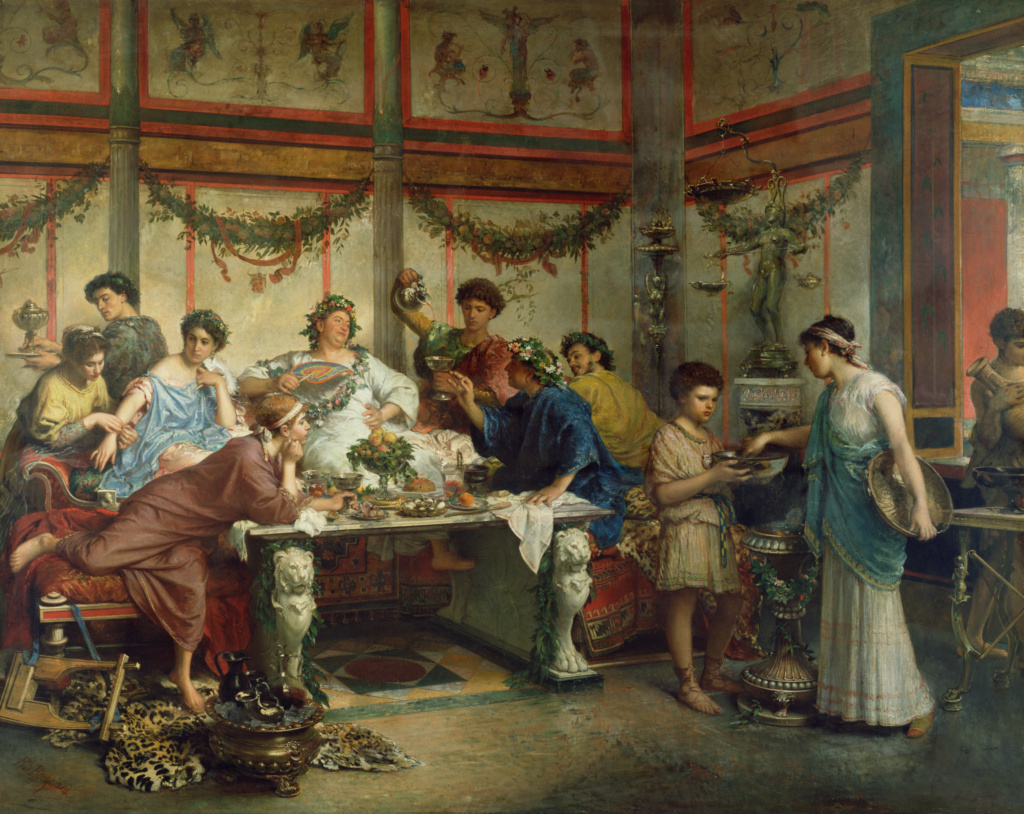
Moreover, the usual social order was not in force: the slaves were free, joining their masters in the celebrations held during the lavish banquets in honour of Saturn.


*** Click here to read our article on the Mundus Cereris, the opening of the Underworld according to the Roman tradition.

The recurring theme is always the same: the "old" that brings the "new", the old and wise darkness that slowly gives way to the light, to the hope of a new year and a new harvest.

Nowadays, we must not worry more about famines and about sharing the harvest with the people we love. We live in an abundant world, full of possibilities. So full to become redundant with it, to the point of losing the sense of joy in being together with those we love, overcoming the darkness.

Let us remember the meaning behind the glitter, behind those gifts bought without feeling and unfailingly recycled. The Solstice is the time to be grateful for what we have received during the year, to be aware of what we have learned during our descent into darkness and to take a new path into the light.

Let us be grateful for the ties we can cultivate around a laid table, be it our blood family or our family of choice. And if we really do not know how to spend our money, let us not buy junk that will end up in the trash: we can use our power to help those who do not have the same luxury.

The Solstice is a festivity linked to joy of the home, the Earth is our home. Let us give us the gift to help her, let us give our money to the associations that take care to protect the environment or people in need. And if we really can not use the money, we can use our time: we can volunteer ourselves, collecting the trash from the beaches and the ground, we give what we do not need to those who can use it.

The greatest gift is to be aware, for ourselves and for those around us.

Happy and prosperous Solstice.


♃Ludna & Unornya
Clicca qui per leggere questo post in Italiano 


venerdì 24 agosto 2018

Caereris Mundus Patet - The Cult of the Dead in Ancient Roman Tradition.


The Caereris Mundus is part of one of the darkest traditions of Italic paganism.
This ritual belongs to the archaic Roman religion, but it is believed that its origin is even more ancient, belonging to the Etruscan religion.


Since, in the Etruscan civilization, cities were built according to some dictates of sacred geometry, the mundus was usually built exactly in the middle of the two main axes of the city, which the Romans would later call Cardo (North-South) and Decumanus (East-West) ), as in a sort of Axis Mundi.

It was a pit so deep that it served as a link between the world of the living and the world of the dead, a temple dedicated to the deities of the underworld, where auspicious rituals were performed to ingratiate both the divinities of the cosmos and those of the underworld.

In particular, this temple was consecrated to the Goddess Ceres; divinity linked to the fertility of the earth and to the cultivation of the fields (its name derives from the suffix -ker which means "the principle of growth"), which was later assimilated the Goddess Demeter. Since the earth contains not only the seeds of the harvest, but is also the place where the bodies of the dead are buried, Ceres was also considered a chthonic deity of the afterlife.

The pit was paved and made spherical, to recall the shape of the earth and the sky, in this way it was recreated a real underground world, with a precise center of gravity in perfect balance, around which it developed the city.

The Mundus remained sealed, closed by the lapis manalis, the sacred stone to the spirits, and was only opened three times a year: August 24th, October 5th and November 8th, days called "Mundus Patet".
This type of ritual had a purifying character, as it took place just before important festivals such as the Saturnalia and the Sol Invictus. The italian word "mondare" derives from the root “mundus" which means “to purify”.


These days were called Dies Religious, and every public activity was suspended, leaving the spirits of the dead, the Mani (manes), to walk freely on our earth plane.
According to the roman official Macrobio, the opening of the mundus would have been a delicate and potentially dangerous moment, not only because of the fear that the dead could possibly invade the earth, but because of the danger that the underworld would attract the living. For this reason, during these days, all the activities concerning the army and the war were suspended.
In these days it was possible to come into contact with the divinities and offer them the fruits of the earth, animal sacrifices or clay tablets on which formulas or requests were written.

THE SPIRITS OF THE ROMAN UNDERWORLD.

According to the Roman religion, depending on the behavior in life of the person, his spirit would have had a different destiny.

Mani:
Their name comes from the Latin manes and means "benevolent", it is the spirits of the dead who still have not found a qualification, they were mainly offered foodstuffs, such as bread and wine.

Lari:
Their name derives from the Latin lares which indicates the domestic hearth.
The Lares are the spirits of the ancestors who watch over the good performance of the family and protect the properties and people of their family of origin. They were given a niche in the domus, where effigies were depicted with the semblance of the dear extinct, which were honored with offerings and dedicating flames to them.

Larvae or Manie:
Those who in life led an evil existence, became Larvae or Manie, malignant spirits that tormented the living and also the Lari Familiares.
They were depicted with the appearance of living dead, skeletal corpses that led to madness (manias) or sucked the energies (larvae) of the people who decided to torment.

FROM THE CULT OF THE UNDERWORLD TO THE CHRISTIAN DAY OF THE DEAD.

When Christianity took over the cults of ancient Rome, which were made illegal, the hard core of paganism, in the countryside, continued with the adoration of the ancient deities and the ancient mystery cults.
The awareness of the relationship between nature, spirits and Gods of the pagans was hard to eradicate for the Christians, who offered them only dogmas in which they could only believe blindly, without rational explanations.

The priestesses of Diana and Ceres used to lay sweets and cakes on the altars of the chthonic deities to attract the spirits of the dead and to provide them with sustenance. In the Roman tradition, it was believed that, behind normal natural events, there was a sort of invisible world that governed them.
For example, the Goddess Diana was defined as Trina (three), as she gave her life, allowed her to grow and then accompanied her at the end, for this reason she was often represented with three heads.

With the aim of predominating over these ancient cults, Christians took possession of the term trino as regards the trinity, father, son and holy spirit, and moved the cult of the dead, which at that time was celebrated in May, in late autumn, at the end of October, when the countryside was now deserted and the harvest were finished.

From here, we arrived at the day of the dead today, which is celebrated in the church on November the 2nd, completely distorted by christianity compared to traditional cults; in fact, we have lost the tranquility and awareness that the ancient priestesses of the Goddess had while recalling the dead, leaving space, no longer to a request for protection to our ancestors, but to a terrible fear of the spirits, unfounded feelings that they were only inculcated in our minds to give the church additional power.
Unornya
Per leggere questo articolo in Italiano clicca qui.


Sources:
Georges Dumézil, La Religione Romana Arcaica, Miti, Leggende, Realtà, 2017.